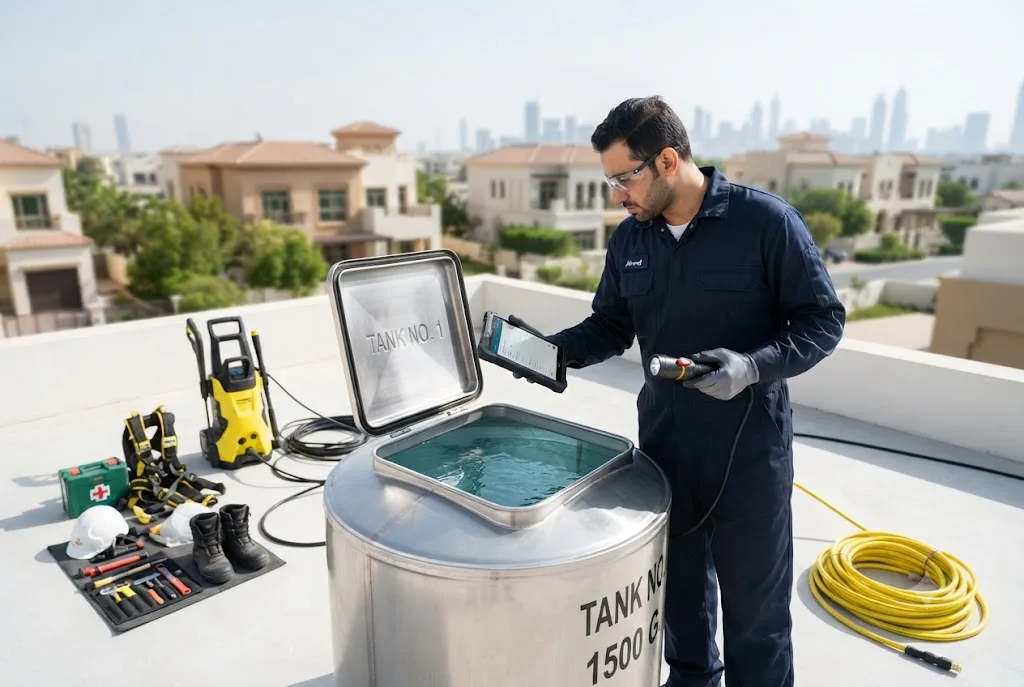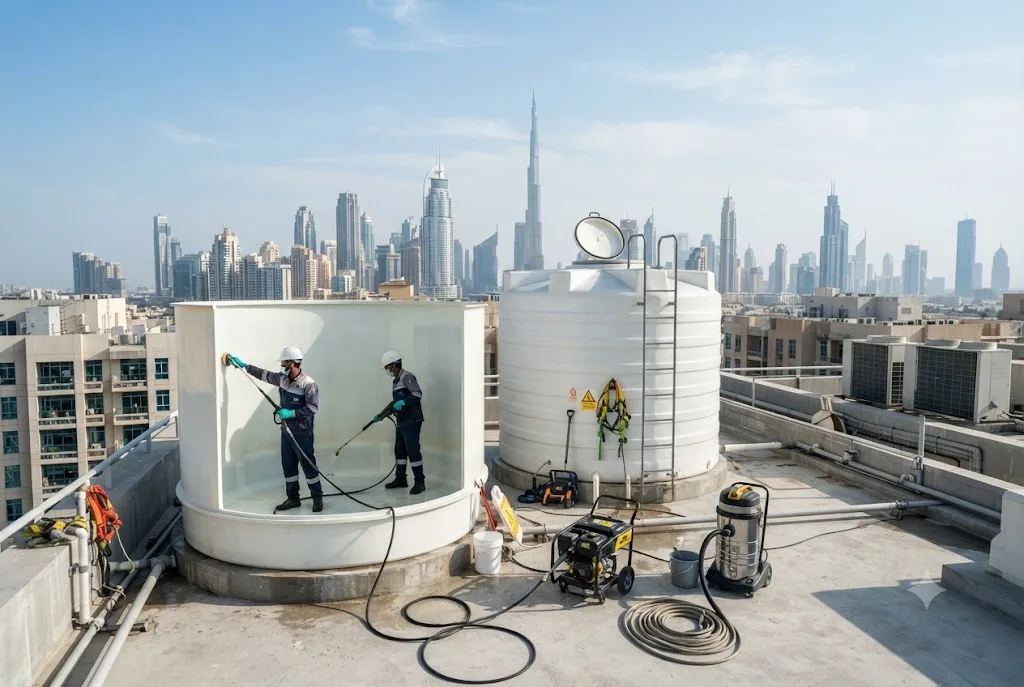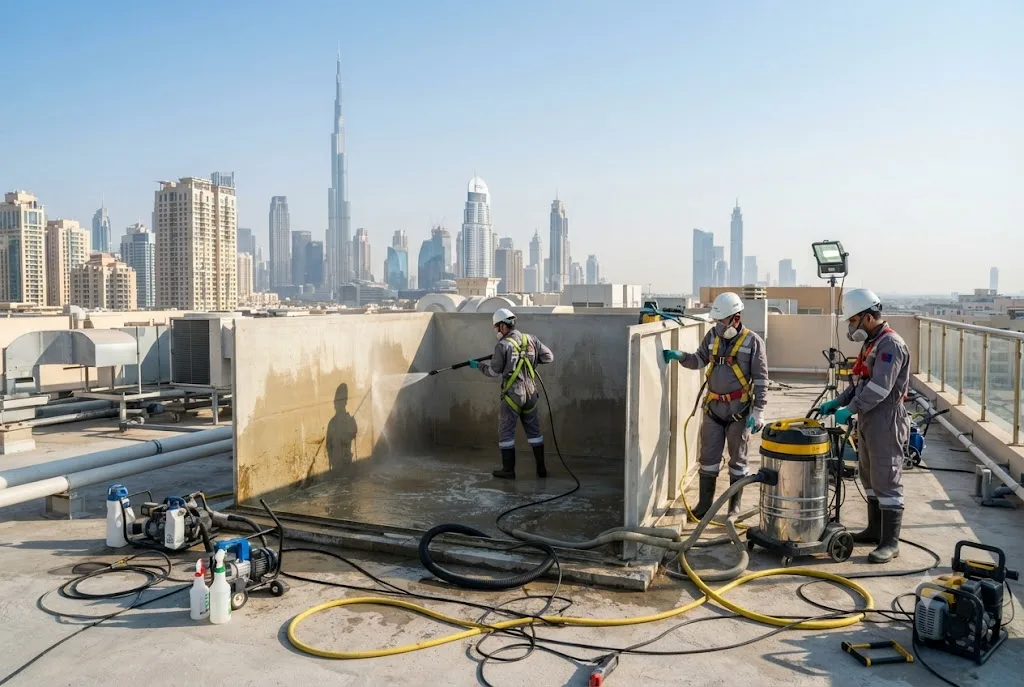
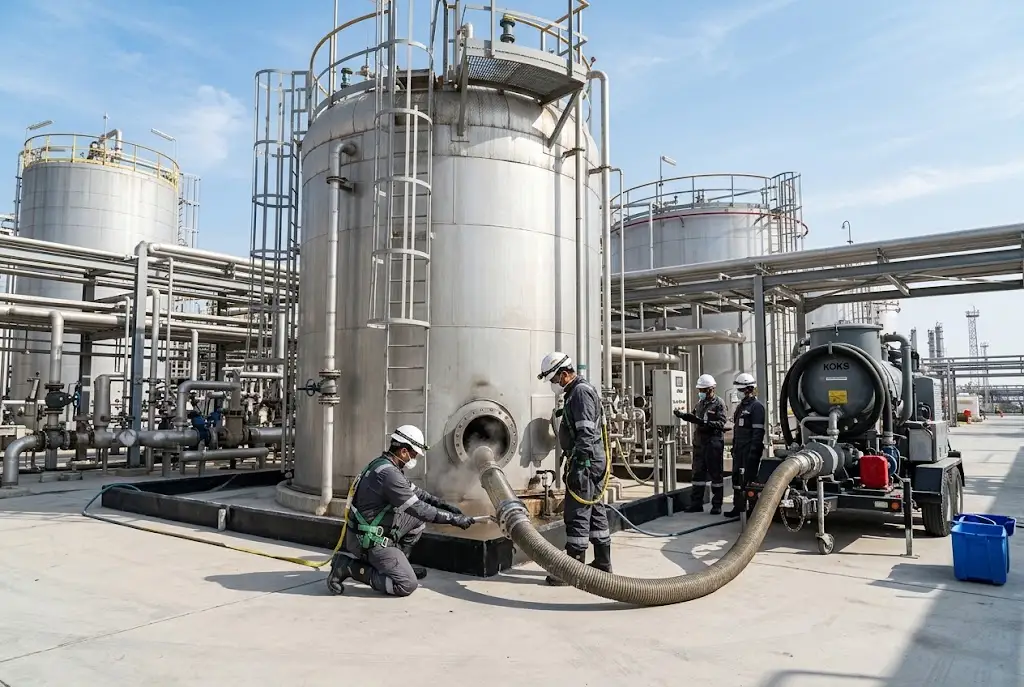
Industrial tank cleaning is a specialized maintenance service that removes accumulated sludge, sediment, process residues, and other contaminants from industrial storage tanks and process vessels. In the UAE, industrial facilities, manufacturing plants, construction operations, fuel storage sites, and commercial properties may require tank cleaning to support maintenance, inspection, operational reliability, and responsible waste management.
Unlike routine domestic tank maintenance, industrial tank cleaning can involve large storage systems, hazardous substances, heavy deposits, restricted access, and complex equipment. The correct approach depends on what the tank contains, how it is constructed, the nature of the residue, and whether the tank will return to service, undergo inspection, or be decommissioned. This guide explains industrial tank cleaning methods, equipment, safety requirements, costs, and how to choose an appropriate contractor in the UAE.
What Is Industrial Tank Cleaning?
Industrial tank cleaning involves removing unwanted material from tanks used to store liquids, process materials, or collect industrial waste. Depending on the facility, these tanks may contain oils, fuels, process liquids, wastewater, chemical residues, or mineral deposits.
Over time, sediments and residues can accumulate on tank floors, walls, fittings, and internal structures. Their composition varies according to the stored material and operating conditions. Some deposits remain relatively loose, while others may become thick, sticky, hardened, or difficult to remove using ordinary pumping equipment.
Professional cleaning may include product recovery, sludge extraction, controlled washing, mechanical cleaning, atmospheric monitoring, inspection support, and waste collection. Not every project requires every stage. A competent contractor should establish the required scope through a site-specific assessment rather than applying one cleaning procedure to every tank.
Why Is Industrial Tank Cleaning Important?
Supporting Equipment Maintenance
Accumulated deposits can interfere with the intended operation of a tank or connected equipment. Depending on the application, contamination may affect usable capacity, material transfer, product quality, or the performance of associated pumps and pipework.
Planned cleaning helps operators remove unwanted deposits and assess whether additional maintenance is necessary. The cleaning schedule should reflect operating conditions, inspection findings, manufacturer guidance, and the requirements of the facility.
Preparing Tanks for Inspection and Repair
Internal deposits can conceal corrosion, coating deterioration, cracks, or other defects. When a tank requires internal inspection, repair, or modification, the work plan may require cleaning to provide suitable access and visibility.
Cleaning does not establish that a tank is structurally sound. Qualified inspection personnel must assess the relevant components and determine whether repairs or further testing are needed before the tank returns to service.
Reducing Contamination Risks
Residues from previous operations may be incompatible with a new product or process. Removing them can be an important part of preparing a tank for a product change, provided the cleaning method addresses the specific contaminants and the intended next use.
Where a tank stores regulated, hazardous, or specialized materials, the operator should establish the applicable acceptance criteria before cleaning begins. A tank that looks clean may still contain residues that require testing or additional treatment.
Managing Industrial Waste Responsibly
Industrial cleaning can generate sludge, contaminated wash water, spent cleaning agents, and other waste streams. Their characteristics depend on the material previously stored and the cleaning method used.
These materials must be collected, assessed, transported, and managed through appropriate authorized routes. The work plan should prevent uncontrolled releases to soil, stormwater drains, or unsuitable disposal locations and identify who is responsible for each waste stream.
Types of Industrial Tank Cleaning Services
The phrase industrial tank cleaning services covers several different activities. Selecting a provider requires identifying the tank type, its previous contents, and the work required.
1. Industrial Storage Tank Cleaning
Industrial storage tank cleaning focuses on tanks that hold raw materials, finished products, process liquids, or other substances used in business operations. The cleaning method depends on tank capacity, internal geometry, residue characteristics, and the level of cleanliness required.
Large storage tanks may need specialized pumping, vacuum extraction, mechanical cleaning equipment, or engineered washing systems. Where possible, operators should consider methods that reduce the need for personnel to enter the tank.
2. Oil and Petroleum Tank Cleaning
Oil storage systems may accumulate hydrocarbons, water, sludge, and other deposits that require specialized handling. Cleaning can be necessary before inspection, repair, maintenance, or a change in service.
Because petroleum residues may create fire, explosion, exposure, and environmental hazards, contractors must understand the relevant material properties and site conditions. For details specific to petroleum storage, see the site’s oil tank cleaning guide.
3. Chemical Process Tank Cleaning
Chemical process tanks may contain substances that react with water, cleaning agents, or residues from previous operations. The cleaning plan must therefore be based on reliable information about the stored material, its safety data sheet, and any known contamination.
Operators should not select a chemical cleaning agent solely because it is commonly used in other facilities. Compatibility, exposure risks, waste generation, and the tank manufacturer’s requirements must be evaluated before work starts.
4. Industrial Wastewater Tank Cleaning
Wastewater tanks can accumulate suspended solids, settled sludge, grease, and other process-related residues. The appropriate method depends on the source of the wastewater and whether it contains industrial chemicals, oils, or other contaminants.
Industrial wastewater should not automatically be treated as ordinary sewage. Its composition and disposal requirements may differ substantially. Where the system is a sewage holding tank, the site’s sewage tank cleaning guide covers the related sanitation service.
5. Specialized Process and Equipment Tanks
Some industrial operations use tanks for drilling fluids, mineral slurries, lubricants, or other specialized materials. These applications may require specific equipment, trained personnel, and waste-handling arrangements.
The contractor should demonstrate experience with the relevant process and residue rather than relying solely on general tank-cleaning experience. Equipment suitability and the acceptance criteria for returning the tank to service should be confirmed before the job begins.
Industrial Tank Cleaning Methods and Equipment
Industrial tank cleaning methods range from external pumping and vacuum extraction to specialized mechanical or automated systems. The most suitable option depends on the tank’s condition, access arrangements, material compatibility, and cleaning objectives.
Vacuum Extraction and Sludge Removal
Suitable industrial vacuum systems can remove liquids, sludge, and other accumulated material. Equipment selection should account for the waste’s consistency, expected solids, transfer distance, and site conditions.
Before work begins, the contractor should establish secure connections, appropriate containment, and a plan for managing the collected material. Vacuum extraction can reduce manual handling, but it does not remove every type of residue or eliminate all atmospheric hazards.
Mechanical Cleaning Equipment
Mechanical brushes, specialized tools, and other equipment may be used to remove deposits from accessible surfaces. The tools must be compatible with the tank material and any internal coatings or linings.
Abrasive tools or unsuitable mechanical methods can damage protective surfaces and create additional maintenance requirements. The contractor should identify the permitted cleaning method before using equipment inside the tank.
Automated Tank Cleaning Machines
Automated cleaning systems can use controlled spray patterns, rotating heads, or other mechanisms to reach surfaces that are difficult to access manually. These systems may help improve consistency and reduce the need for direct human access in suitable applications.
However, an automated machine is not automatically suitable for every industrial tank. The process must account for pressure limits, residue characteristics, equipment compatibility, and the safe management of wash water and removed material.
Controlled Washing and Chemical Cleaning
Some projects require water-based washing or specialized cleaning agents to remove residues that cannot be addressed by pumping alone. The selected method must consider chemical compatibility, worker exposure, the tank’s construction, and the destination of the resulting waste.
Cleaning agents should never be mixed without verified compatibility and an approved procedure. The contractor must follow the applicable product instructions, site requirements, and waste-management controls.
Industrial Tank Cleaning Safety Requirements
Industrial tank cleaning can expose workers to hazardous substances, flammable vapours, oxygen deficiency, moving machinery, pressure-related hazards, and restricted access. Safe execution requires a documented work plan, competent supervision, appropriate equipment, and effective emergency arrangements.
Risk Assessment and Method Statement
Before work starts, a competent person should assess the tank, its previous contents, connected equipment, work area, access arrangements, and proposed cleaning method. The resulting risk assessment and method statement should identify the hazards, controls, personnel responsibilities, and emergency procedures.
The assessment should be reviewed if the actual residue differs from expectations, equipment changes, or unexpected conditions arise. Workers should understand the agreed procedure and know when to stop work.
Isolation of Equipment and Energy Sources
Connected pipelines, pumps, mixers, valves, and other equipment can create hazards if they operate unexpectedly or introduce additional material into the tank. Appropriate isolation and lockout procedures should be applied before maintenance or cleaning begins.
The facility’s approved isolation process should address the relevant electrical, mechanical, hydraulic, pneumatic, and process-energy sources. Turning off a control switch alone may not provide adequate protection.
Confined-Space Precautions
Some industrial tanks may qualify as confined spaces and can contain hazardous atmospheres or other life-threatening conditions. A tank should never be considered safe for entry merely because it has been emptied, washed, or left open.
Where entry is required, a competent assessment must establish the necessary controls. Depending on the circumstances, these may include an entry permit, isolation, atmospheric testing, ventilation, a trained attendant, reliable communication, and a suitable rescue plan.
Workers must not attempt an improvised rescue inside a tank. Emergency response arrangements should be established before work begins and must match the identified hazards.
Fire, Explosion, and Atmospheric Hazards
Tanks that previously held fuels, solvents, or other volatile substances may retain hazardous vapours. Cleaning operations can also disturb residues and change the conditions inside the tank.
The work plan should address ignition sources, equipment suitability, atmospheric monitoring, ventilation, and other controls appropriate to the material and hazardous-area classification. Hot work must not proceed until the required authorization and safety conditions have been verified.
Personal Protective Equipment
Depending on the job, workers may require chemical-compatible gloves, protective clothing, eye and face protection, safety footwear, head protection, or respiratory protection under a suitable programme.
Protective equipment must be selected according to the actual exposure risks. It does not replace required isolation, ventilation, atmospheric testing, or other engineering and procedural controls.
Environmental Protection and Waste Disposal
Before cleaning starts, identify the expected waste streams and confirm the arrangements for collection, temporary storage, transport, and disposal. Containment measures should address possible leaks from hoses, pumps, transfer points, and waste containers.
Industrial operators in the UAE should verify the applicable environmental, waste transport, treatment, and disposal requirements for their emirate and type of facility. Waste handling responsibilities should be documented in the work agreement.
The OSHA guidance on tank cleaning operations provides a useful reference for planning, isolation, residue removal, atmospheric assessment, cleaning, and return-to-service activities. It is US guidance and does not replace applicable UAE requirements or site-specific procedures.
How to Choose an Industrial Tank Cleaning Company in the UAE
Choosing an industrial tank cleaning company requires evaluating technical competence, relevant experience, safety procedures, equipment, and waste-handling arrangements. The contractor should be qualified for the specific tank and material involved.
Verify Relevant Industrial Experience
Ask whether the company has previously cleaned comparable tanks and handled similar residues. Experience with ordinary building water tanks does not establish competence in petroleum, chemical, or other hazardous industrial applications.
Review Safety Documentation
Request the proposed risk assessment, method statement, personnel competency information, and emergency arrangements. For higher-risk work, clarify how the contractor will manage isolation, atmospheric testing, confined-space entry, and rescue requirements.
Confirm Equipment Suitability
Ask which pumps, vacuum systems, mechanical tools, cleaning machines, and monitoring instruments will be used. Confirm that the equipment is appropriate for the tank’s material, residue, access arrangements, and operating environment.
Clarify Waste Collection and Disposal
The contractor should explain how the removed sludge, liquids, and cleaning residues will be managed. Establish who is responsible for waste classification, transport, and disposal, and what documentation will be provided.
Compare the Full Scope of Work
One quotation may cover only pumping and residue removal, while another includes cleaning, atmospheric monitoring, inspection support, waste management, and final reporting. Compare the deliverables and exclusions before making a decision.
A written scope helps prevent misunderstandings and clarifies which additional activities may require separate approval or payment.
What Affects Industrial Tank Cleaning Costs?
Industrial tank cleaning costs depend on the tank, the residue, the required safety measures, and the scope of work. Key factors include:
- Tank size and design: Capacity, shape, internal structures, and access points affect equipment and labour requirements.
- Stored material: Petroleum, chemicals, wastewater, and process residues can require different methods and precautions.
- Sludge volume and condition: Thick or hardened deposits may take longer to remove than loose material.
- Safety requirements: Atmospheric monitoring, isolation, specialist equipment, and confined-space controls may affect the project scope.
- Waste management: Collection, testing where required, transport, treatment, and disposal contribute to overall costs.
- Inspection and repair work: Additional inspection, coating repairs, or structural maintenance may be needed.
- Site access and scheduling: Restricted access, operational shutdowns, and urgent attendance can affect resources and timing.
To obtain a meaningful quotation, provide the contractor with the tank’s dimensions or capacity, previous contents, location, access arrangements, known residue conditions, and intended use after cleaning. Ask for a written breakdown of cleaning, waste handling, inspection, and any optional services.
How Often Should Industrial Tanks Be Cleaned?
There is no universal cleaning frequency for all industrial tanks. The appropriate interval depends on the stored material, operating conditions, inspection results, manufacturer recommendations, process requirements, and applicable regulations or industry standards.
Some tanks require cleaning before internal inspection, repair, decommissioning, or a product change. Others may need intervention when deposits affect operation or when inspections identify a maintenance requirement.
A planned maintenance programme should record inspections, cleaning dates, residue conditions, defects, and follow-up actions. This information helps operators decide when cleaning is necessary instead of relying on an arbitrary schedule.
Industrial Tank Cleaning vs. Residential Water Tank Cleaning
Industrial tank cleaning and residential drinking water tank cleaning serve different purposes and require different procedures. The Industrial tanks may contain fuels, chemicals, process residues, or contaminated wastewater, while potable-water tanks must be maintained to protect water hygiene.
The equipment, cleaning products, protective measures, waste-handling requirements, and return-to-service criteria must match the tank’s intended use. Tools exposed to industrial chemicals or petroleum residues must not be reused for drinking water systems without an appropriate validated decontamination and suitability assessment.
For residential and commercial potable-water systems, see the site’s water tank cleaning guide for the UAE. The separate tank cleaning services page also provides a general starting point for understanding tank maintenance services.
Frequently Asked Questions About Industrial Tank Cleaning
What do industrial tank cleaning services include?
Depending on the project, services may include initial assessment, product recovery, sludge removal, internal cleaning, atmospheric monitoring, waste handling, inspection support, and service documentation. Confirm the exact scope before work begins.
What is the difference between tank cleaning and tank washing?
Tank washing usually refers to a washing stage, while tank cleaning can involve a broader process that includes residue recovery, sludge extraction, cleaning, inspection, and waste management. The terminology varies by industry, so the agreed scope should define the actual work.
Can an industrial tank be cleaned without entry?
Some tanks can be cleaned using external connections, vacuum extraction, or automated equipment. Whether a non-entry method can achieve the required result depends on the tank design, residue, and cleaning objective. A competent assessment should consider non-entry options before internal entry is proposed.
Does every industrial tank need chemical cleaning?
No. Some tanks can be serviced using mechanical removal, pumping, or other suitable methods. Chemical cleaning should be considered only when appropriate for the residue and tank materials and when its safety, compatibility, and waste requirements have been evaluated.
What should be checked before a tank returns to service?
The required checks depend on the tank’s purpose and the work performed. They may include verification of cleanliness, inspection findings, equipment condition, removal of temporary connections, completion of repairs, and any specified testing or approvals.
Final Thoughts
Industrial tank cleaning supports maintenance, residue removal, inspection, and reliable operation across a wide range of industrial facilities. However, the correct approach depends on the tank’s contents, condition, access arrangements, and intended use after cleaning.
For UAE businesses, a suitable contractor should demonstrate relevant technical experience, provide a site-specific work plan, control occupational and environmental risks, and explain how recovered waste will be managed. Careful planning and clear documentation help operators make informed maintenance decisions while protecting workers, equipment, and the surrounding environment.