
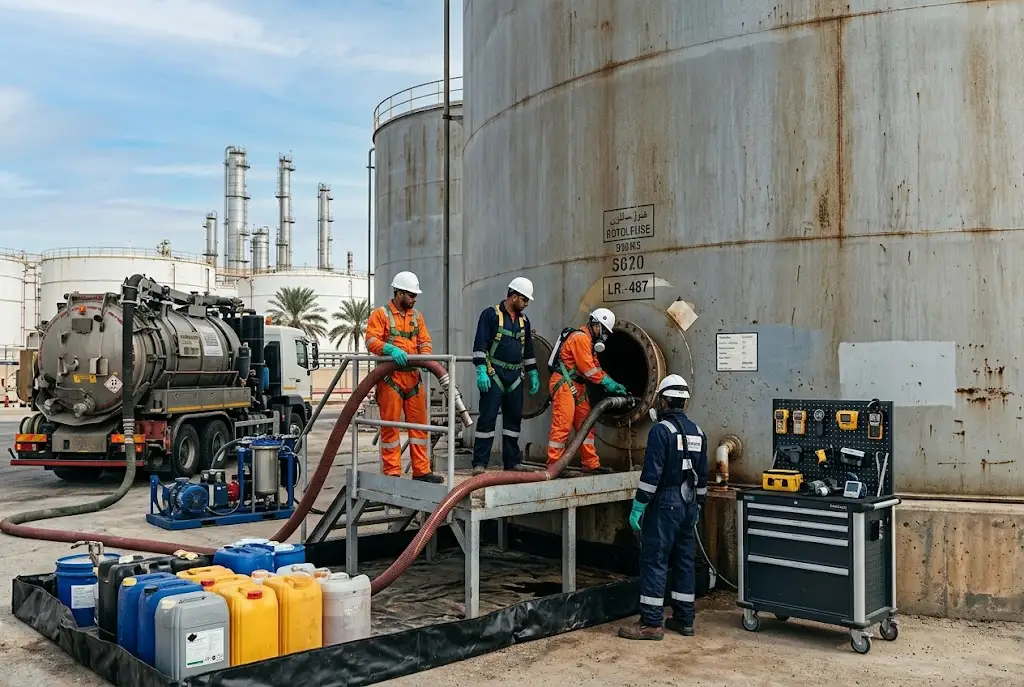
Oil tank cleaning is an essential industrial maintenance activity that removes accumulated sludge, residual hydrocarbons, sediment, and other deposits from petroleum and fuel storage tanks. In the UAE, where fuel storage, transport, marine operations, construction, and industrial facilities support a wide range of businesses, tank cleaning requires careful planning, appropriate equipment, and strict control of workplace and environmental hazards.
Unlike routine water tank maintenance, cleaning an oil storage tank can involve flammable vapours, toxic residues, oxygen-deficient atmospheres, and hazardous waste. The correct method depends on the tank’s previous contents, construction, condition, and intended use after cleaning. This guide explains the main oil tank cleaning methods, industrial applications, safety requirements, contractor selection criteria, and important considerations for UAE businesses.
What Is Oil Tank Cleaning?
Oil tank cleaning is the controlled removal of residual oil, sludge, sediment, scale, and other contaminants from tanks used to store or process petroleum products. These tanks may be located at fuel depots, industrial plants, transport facilities, marine terminals, workshops, or commercial properties with dedicated fuel storage systems.
Over time, stored products can leave deposits at the bottom of a tank. Depending on the fuel and operating conditions, these deposits may include hydrocarbons, water, rust, dirt, degraded product, and other residues. Accumulation can interfere with inspection, reduce usable storage capacity, complicate maintenance, or affect the quality of subsequently stored products.
However, an oil tank should not be cleaned simply because it contains visible sludge. The facility operator should establish the reason for cleaning, identify the previous contents, determine whether the tank must be inspected or repaired, and arrange safe handling of all recovered materials.
Why Is Oil Tank Cleaning Important for Industrial Facilities?
Removing Sludge and Deposits
Oil sludge can accumulate at tank bottoms and around internal structures. Depending on the product, it may become thick, sticky, or difficult to remove using ordinary pumping equipment. Appropriate industrial cleaning methods help recover removable material and prepare the tank for further maintenance.
Supporting Tank Inspection and Maintenance
Deposits can conceal corrosion, coating deterioration, cracks, or other defects. Cleaning may be necessary before a qualified inspector can assess the tank’s internal condition. Where inspection or repair is planned, the cleaning contractor should coordinate the work sequence with the facility operator and inspection team.
Reducing Operational Problems
Contaminants can affect fuel handling, product quality, and associated equipment. A planned cleaning programme can help operators address accumulated residues before they interfere with normal operations. Nevertheless, cleaning frequency should be based on the tank’s service conditions, inspection findings, product specifications, and the manufacturer’s or facility’s maintenance requirements.
Managing Environmental Risks
Oil residues and contaminated wash water must not be allowed to enter soil, stormwater drains, or other unsuitable disposal routes. Effective tank cleaning includes containment, collection, transport, and disposal of recovered waste through an appropriate authorized route. The correct arrangements depend on the waste characteristics and applicable UAE emirate-level requirements.
Types of Oil Tank Cleaning Services
Different tanks require different procedures. A contractor experienced in one type of tank should not automatically be considered qualified to clean every petroleum or industrial storage system.
1. Petroleum Tank Cleaning
Petroleum tank cleaning involves removing residues from tanks that have stored crude oil, refined petroleum products, or other oil-based materials. The cleaning plan depends on the product’s properties, the volume and consistency of deposits, tank design, and the intended work after cleaning.
Petroleum tanks may require product recovery, sludge removal, vapour management, atmospheric testing, surface cleaning, and inspection. The facility’s approved work procedures determine which activities are necessary and how they must be carried out.
2. Diesel Tank Cleaning Service
A diesel tank cleaning service is relevant to fuel storage systems used by generators, commercial vehicles, industrial equipment, construction machinery, and other diesel-powered operations. Contamination may include sediment, water, corrosion products, and fuel degradation deposits.
The contractor should identify the tank’s configuration and the source of contamination before selecting a cleaning method. Fuel recovery, waste collection, and any subsequent inspection or filtration requirements should be included in the agreed scope of work.
3. Industrial Oil Storage Tank Cleaning
Industrial facilities may use tanks for lubricating oils, process oils, recovered oils, or other specialized products. These materials can have different chemical properties and may require specific handling, cleaning agents, waste classifications, and protective measures.
Before work starts, the contractor should review available product information and safety data sheets. The cleaning procedure should account for possible chemical incompatibilities, residues from previous operations, and the requirements of the equipment manufacturer or facility operator.
4. Ship Tank Cleaning
Ship tank cleaning is a specialized marine operation involving cargo tanks, fuel tanks, or other designated onboard storage systems. Requirements vary according to the vessel, previous cargo, tank design, maritime rules, and the next intended cargo or maintenance activity.
Marine tank cleaning may require coordination with the vessel’s officers, terminal personnel, marine safety specialists, and qualified contractors. Cargo residues and wash water must be managed under the applicable maritime and environmental requirements. Ship tank cleaning should therefore be treated as a separate specialist service rather than an extension of ordinary building maintenance.
5. Mud Tank Cleaning
Mud tank cleaning is associated with drilling and other specialized industrial operations where tanks contain drilling fluids, solids, and accumulated sediment. These materials may have different handling and disposal requirements from petroleum fuel residues.
The contractor must identify the drilling fluid and any associated chemicals before choosing equipment or waste-handling arrangements. Depending on the facility and material, cleaning may involve solids separation, mechanical removal, controlled washing, and collection of contaminated liquids.
How Does the Oil Tank Cleaning Process Work?
A professional oil tank cleaning project normally follows a documented sequence. The exact procedure varies by tank type, previous contents, contamination, and the work being performed. The following stages provide a general overview, not a substitute for an approved site-specific method statement.
Step 1: Initial Inspection and Planning
The contractor and facility operator establish the tank’s purpose, dimensions, previous contents, condition, access arrangements, and cleaning objectives. They also identify nearby equipment, connected pipelines, possible sources of ignition, environmental risks, and any requirement for internal inspection or repair.
This assessment informs the work scope, equipment selection, personnel requirements, waste arrangements, and emergency planning.
Step 2: Isolation and Product Recovery
Before cleaning, the tank must be taken out of service and isolated using the facility’s approved procedures. Relevant pipelines, valves, pumps, and energy sources must be controlled to prevent unexpected product flow or equipment activation.
Recoverable oil may be removed through suitable connections and pumping systems. Recovery methods must be compatible with the product and equipment and must control leakage, static electricity, ignition sources, and exposure to hazardous vapours.
Step 3: Sludge and Residue Removal
After recoverable product has been addressed, remaining sludge and deposits are removed using an appropriate method. Depending on the tank and material, this may involve specialized suction equipment, vacuum systems, mechanical tools, or other engineered approaches.
Where feasible, methods that reduce the need for workers to enter the tank should be considered. The contractor must also establish how sludge and residual liquids will be contained, characterized, transported, and disposed of.
Step 4: Degassing and Atmospheric Assessment
Oil residues can release hazardous vapours even after the bulk liquid has been removed. Depending on the material, hazards may include flammable atmospheres, toxic gases, and oxygen deficiency. An apparently empty tank must not be assumed safe for entry.
Where required, qualified personnel establish and verify acceptable atmospheric conditions using suitable, calibrated monitoring equipment. Ventilation, vapour control, and other measures must follow the approved procedure. Atmospheric conditions may need continuous or repeated monitoring during the work.
Step 5: Internal Cleaning
Internal cleaning may involve compatible cleaning agents, controlled washing, mechanical removal, or specialized cleaning machinery. The selected process must account for the tank material, residue characteristics, ignition risks, waste generation, and the next intended use of the tank.
Any entry into the tank must be managed under the applicable confined-space and site permit procedures. Workers must not enter solely because the tank has been drained, ventilated, or washed.
Step 6: Inspection and Return to Service
Once the specified cleaning work is complete, the tank is inspected to verify that the agreed scope has been achieved. Depending on the project, this may include checking for remaining deposits, corrosion, coating damage, structural defects, or other maintenance issues.
The facility operator should verify that the required checks, documentation, and approvals are complete before the tank is returned to service. Recommissioning must follow a controlled procedure that addresses isolation removal, connected systems, the intended stored product, and any remaining atmospheric or operational hazards.
Oil Tank Cleaning Safety Requirements
Industrial tank cleaning can expose workers to serious hazards. A safe job requires more than protective clothing; it depends on planning, engineering controls, trained personnel, suitable equipment, and effective emergency arrangements.
Confined-Space Entry Controls
Many petroleum storage tanks have restricted access and are not designed for continuous human occupancy. Depending on their characteristics, they may qualify as permit-required confined spaces under the relevant safety framework.
Before authorizing entry, the responsible team must assess physical and atmospheric hazards and implement the controls required by applicable rules and site procedures. These may include a written permit, energy isolation, atmospheric testing, ventilation, an attendant, communication systems, and a suitable rescue plan.
Workers must never attempt an improvised rescue inside a tank. Emergency response must be planned in advance, and rescuers must have the training and equipment required for the identified hazards.
Fire and Explosion Prevention
Flammable vapours can ignite when exposed to an unsuitable electrical device, a spark, static discharge, hot work, or another ignition source. The work plan should identify hazardous areas and establish appropriate controls for electrical equipment, bonding and grounding, ventilation, and nearby activities.
Hot work must not begin until the relevant authorization, isolation, testing, and other required conditions have been verified. A tank that previously held oil can remain hazardous even when no liquid is visible.
Personal Protective Equipment
Protective equipment should be selected according to the specific substances, exposure routes, and task. Depending on the risk assessment, workers may need chemical-compatible gloves, protective clothing, eye and face protection, suitable footwear, head protection, and respiratory protection under an appropriate programme.
PPE does not replace safe isolation, atmospheric monitoring, ventilation, or other required controls. The contractor should also provide suitable training and arrangements for cleaning, inspecting, and handling contaminated equipment.
Environmental and Waste Controls
Oil sludge, contaminated water, spent cleaning products, and disposable protective materials may require specialized waste handling. The contractor should identify the waste streams before work begins and confirm that the proposed collection, transport, treatment, and disposal arrangements are permitted.
Spill prevention measures should be established around pumps, hoses, transfer points, and temporary storage areas. The work plan should also explain how accidental releases will be contained and reported under the applicable requirements.
The OSHA guidance on tank cleaning operations provides a useful reference for preplanning, isolation, product recovery, degassing, atmospheric testing, cleaning, and recommissioning. OSHA is a United States authority, so its guidance should supplement rather than replace applicable UAE laws, local requirements, and facility procedures.
How to Choose Oil Tank Cleaning Companies in UAE
Selecting among oil tank cleaning companies in UAE requires more than comparing quotations. Industrial tank cleaning involves specialized risks, and the contractor’s experience must match the actual tank, product, and work scope.
Check Relevant Experience
Ask whether the contractor has experience with the specific type of tank involved, such as diesel storage, petroleum tanks, industrial oil systems, or marine applications. Experience with domestic water tanks alone is not sufficient evidence of competence in hazardous industrial tank cleaning.
Review Safety Documentation
Request the proposed risk assessment, method statement, personnel competency records, emergency arrangements, and any permits or approvals required for the job. The documents should address the actual site conditions rather than relying on generic statements.
Confirm Equipment and Waste Arrangements
Ask which pumps, vacuum systems, monitoring instruments, ventilation equipment, and protective systems will be used. Confirm that the equipment is appropriate for the material and hazardous-area classification, where applicable.
Also clarify who is responsible for sludge collection, waste classification, transportation, and disposal. These activities should be included in the contract or clearly assigned to another qualified party.
Compare the Full Scope of Work
Two quotations may cover different services. One may include only product recovery and sludge removal, while another may include internal cleaning, atmospheric monitoring, inspection support, waste management, and final documentation.
Compare the proposed method, exclusions, schedule, safety arrangements, and deliverables before making a decision. A clearly defined scope helps avoid disputes and unexpected charges during the project.
What Affects the Cost of Oil Tank Cleaning?
Oil tank cleaning costs vary according to the project rather than a single standard rate. Important factors include:
- Tank size and configuration: Capacity, shape, access points, and internal structures influence the equipment and labour required.
- Type of stored product: Diesel, crude oil, lubricants, and specialized industrial materials can leave different residues and create different hazards.
- Sludge volume and condition: Thick, hardened, or heavily accumulated deposits may require additional removal work.
- Safety requirements: Atmospheric monitoring, specialist ventilation, confined-space controls, and emergency provisions can affect the project scope.
- Waste handling: Containment, testing, transportation, treatment, and disposal requirements may contribute significantly to the total cost.
- Inspection and repairs: Additional inspection, coating work, or repairs may be necessary after cleaning, depending on the tank’s condition.
- Operational scheduling: Shutdown coordination, access restrictions, and urgent work may influence the quotation.
For a meaningful estimate, provide the contractor with the tank’s capacity, previous contents, location, approximate sludge level, access details, and intended purpose after cleaning. Ask for a written quotation that separates cleaning, waste management, inspection, and additional work wherever possible.
How Often Should an Oil Storage Tank Be Cleaned?
There is no single cleaning interval suitable for every oil storage tank. The appropriate schedule depends on the product stored, operating conditions, contamination history, inspection findings, manufacturer recommendations, and applicable industry or facility requirements.
Some tanks may need cleaning before an internal inspection, repair, product change, or decommissioning. Others may require intervention when testing or operating records indicate a problem. An established maintenance programme should define how the tank is monitored and when cleaning is necessary.
Rather than choosing a frequency based only on the calendar, operators should use documented inspection findings and operating information to plan maintenance. This approach helps ensure that cleaning is performed when justified and that significant defects are not overlooked.
Oil Tank Cleaning Versus Water Tank Cleaning
Oil tank cleaning and drinking water tank cleaning are distinct services with different technical and safety requirements. Although both involve removing deposits from storage tanks, the materials, cleaning methods, and return-to-service criteria are not interchangeable.
Oil tanks may contain combustible residues, hydrocarbon vapours, hazardous sludge, and substances requiring specialized disposal. Drinking water tanks, by contrast, must be cleaned and disinfected using methods and materials suitable for potable-water storage.
For residential or commercial potable-water systems, the site’s water tank cleaning guide for the UAE covers a different maintenance need. Do not apply a petroleum tank cleaning procedure or reuse equipment contaminated by oil in a drinking water system.
Businesses seeking a general overview of the site’s tank-related services can also review tank cleaning services, while confirming that any selected provider is specifically qualified for industrial petroleum work.
Frequently Asked Questions About Oil Tank Cleaning
What does an oil tank cleaning service include?
The scope may include initial inspection, isolation planning, recoverable product removal, sludge extraction, degassing, atmospheric monitoring, internal cleaning, waste handling, and final inspection. The exact inclusions depend on the tank and the written agreement.
Can an oil tank be cleaned without entering it?
Some stages of cleaning can be performed using external connections, suitable pumping systems, or specialized equipment. Whether the entire job can be completed without entry depends on tank design, contamination, and the required outcome. The contractor should evaluate non-entry methods before proposing internal entry.
Is diesel tank cleaning different from petroleum tank cleaning?
The procedures can overlap, but the correct method depends on the stored product, tank condition, contamination, and intended use. A diesel tank may contain water, sediment, degraded fuel, or other residues that require a suitable assessment and handling method.
What happens to oil sludge removed from a tank?
Recovered sludge should be assessed and managed according to its characteristics and applicable waste requirements. It must be contained and transported through an appropriate authorized route rather than discharged into ordinary drains or onto the ground.
Can ordinary cleaning equipment be used inside an oil tank?
Not without an assessment. Equipment must be compatible with the residue and working environment, and electrical or mechanical equipment must meet the applicable safety requirements. A hazardous atmosphere may make ordinary tools unsuitable.
Final Thoughts
Oil tank cleaning is a specialized industrial service that supports maintenance, residue removal, inspection, and responsible management of petroleum storage systems. Its success depends on understanding the tank’s previous contents, choosing an appropriate cleaning method, controlling hazardous atmospheres, and managing recovered waste correctly.
For UAE businesses, the most suitable contractor is one that can demonstrate relevant industrial experience, provide a site-specific method statement and risk assessment, explain the equipment and waste-handling arrangements, and complete the required checks before returning the tank to service.
By treating oil tank cleaning as a planned industrial operation rather than an ordinary washing task, facility operators can make more informed maintenance decisions while protecting workers, equipment, and the surrounding environment.