Emergency home maintenance in Dubai begins with classification. A burning smell near an electrical point is not the same as a slow drain. An active AC water leak above a ceiling is more urgent than weak cooling in one room. The correct first response is to protect people, limit damage where it is safe to do so, and give the maintenance team clear information.
Homeowners should avoid dismantling electrical, refrigerant, pump or concealed plumbing systems. The purpose of first response is not to complete the repair. It is to decide whether the fault is an emergency, a same-day technical issue or a planned maintenance item.
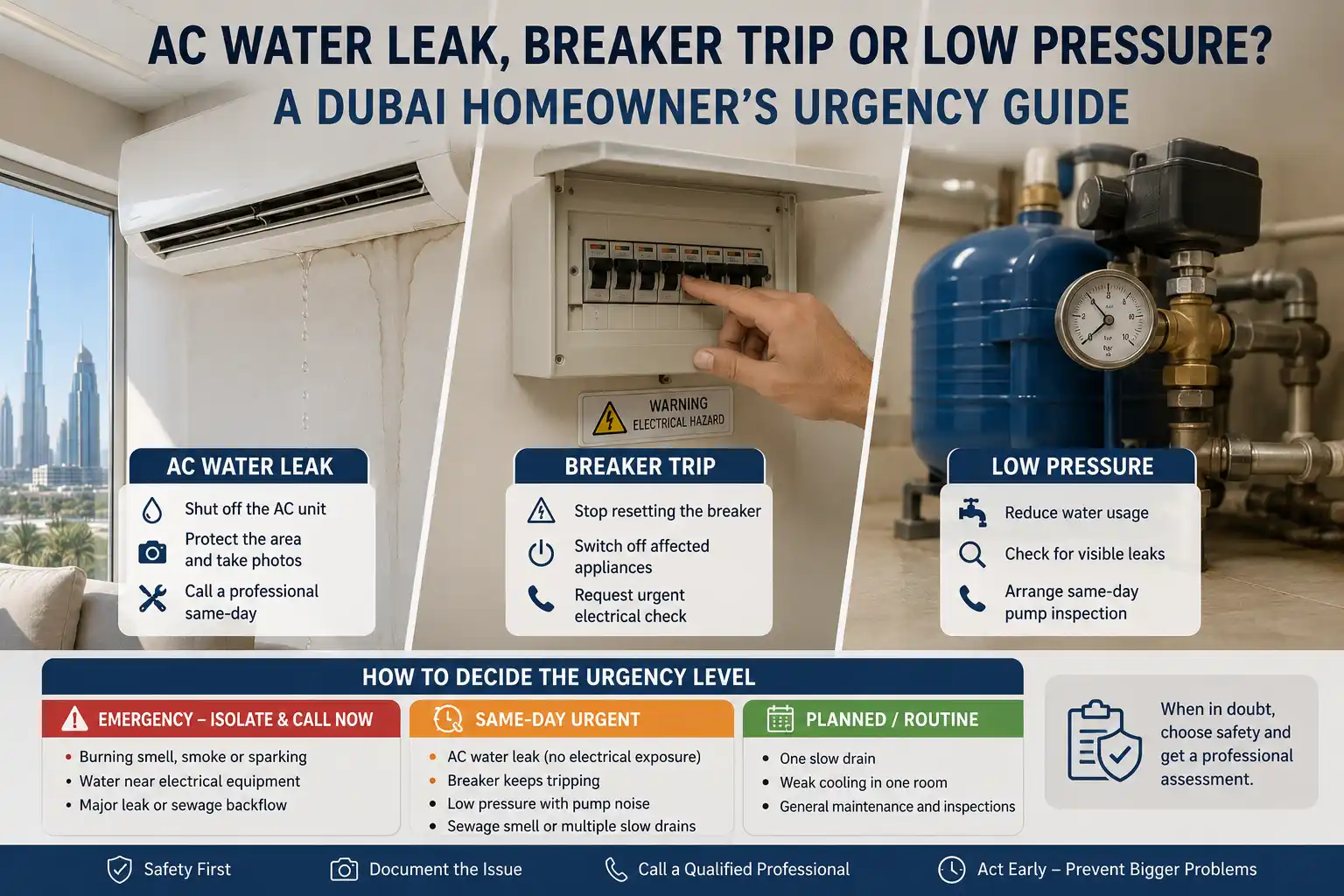
The following guide uses three urgency levels: isolate and call now, same-day assessment, and planned inspection.
The Home Fault Urgency Matrix
| Symptom | Safe first action | Urgency | Why |
| Burning smell, smoke, sparking or a hot electrical point | Keep people away. Isolate power only if the correct point can be reached safely. | Emergency | Potential fire or electrical risk |
| Active water leak near electrical equipment or premium finishes | Stop using the affected unit. Isolate the local water or AC unit only where safe and known. | Emergency / urgent | Risk of electrical exposure and secondary damage |
| Repeated breaker trip | Stop repeated resetting and switch off the affected equipment. | Same-day urgent | May indicate an equipment, wiring or load fault |
| AC water leak with no electrical exposure | Switch off the affected AC unit, protect the area and photograph the source. | Same-day urgent | Ongoing ceiling, wall or joinery damage |
| Sewage backflow or wastewater entering the property | Stop using affected fixtures and isolate the area. | Same-day urgent | Hygiene and property-damage risk |
| Low water pressure with abnormal pump noise | Reduce unnecessary water use and note when the problem occurs. | Priority assessment | Possible pump, control, tank or supply issue |
| One slow drain with no overflow | Avoid chemical overuse and monitor whether other fixtures are affected. | Planned | Likely local restriction unless symptoms spread |
| Weak cooling in one room | Check thermostat setting, open vents and obvious airflow obstruction only. | Planned / priority | May be airflow, control or equipment related |
Level 1: Isolate and Call Now
An emergency exists when there is an immediate safety risk, uncontrolled active damage or loss of an essential service that cannot be managed safely.
Burning Smell, Smoke, Heat or Sparking
A burning smell, visible smoke, sparking, discolouration or unusual heat around a socket, switch, appliance connection or electrical panel requires immediate caution. Do not touch the affected point or attempt to open a panel.
Keep people away. If the correct local switch or breaker can be identified and reached without approaching the hazard, isolate it. If there is smoke, fire or uncertainty, contact the appropriate emergency service and do not re-energise the circuit.
Water Near Electrical Equipment
Water leaking near lights, sockets, distribution boards, appliances or other electrical equipment increases the urgency. Do not stand in pooled water or touch wet electrical points.
Switch off the affected AC unit or local water source only where the control is known and safely accessible. Move people and movable belongings away from the area, then request professional attendance.
Uncontrolled Leak or Major Overflow
An active leak that is rapidly spreading, affecting ceilings or damaging finishes needs urgent action. Where the correct local isolation valve is clearly known and safely accessible, close it. Do not force unknown or seized valves.
Photograph the visible source, the affected area and any equipment involved. This helps the responding team prepare the correct tools and determine whether plumbing, AC drainage, waterproofing or another system may be involved.
Level 2: Same-Day Technical Assessment
Some faults do not present an immediate life-safety risk but can become expensive or disruptive if left operating. These should normally receive same-day or priority assessment.
AC Water Leakage
AC water leakage is usually linked to condensate drainage, drain-pan condition, insulation or another installation issue. The visible drip may not be directly below the source because water can travel through ceilings or along services.
Switch off the affected unit, protect nearby finishes and note when the leak began. Do not continue operating the unit simply because a container can catch the water. The leak may worsen or spread into concealed areas.
Breaker Keeps Tripping
A breaker is a protective device. Repeatedly resetting it without identifying the cause is not a repair. The fault may involve the connected appliance, AC equipment, wiring, moisture or electrical loading.
Leave the affected equipment off and report which breaker trips, what was operating at the time, whether there was smell or heat, and whether the trip is immediate or delayed.
Sewage Backflow or Several Slow Drains
One slow basin may indicate a local blockage. Several slow fixtures, gurgling, sewage odour or wastewater returning through a drain may point to a wider restriction.
Stop using affected fixtures and avoid adding chemical cleaners. Backflow requires prompt investigation because continued use can increase overflow and contamination.
Low Water Pressure and Pump Symptoms
Low pressure can result from a local fixture issue, partially closed valve, supply condition, pump problem, pressure vessel, tank level, sensor or control fault. The pattern is important.
Note whether the problem affects the entire property or one fixture, whether it is constant or intermittent, and whether a pump is cycling, vibrating or making unusual noise.
Recurring leakage, drainage blockage or pressure instability may require professional plumbing and drainage support that assesses the wider system rather than treating each symptom as an isolated repair.
Level 3: Planned Inspection
A planned issue is not necessarily unimportant. It means the condition is stable enough to schedule safely, provided it is monitored and does not worsen.
Weak Cooling in One Room
Check the thermostat setting, confirm the vent is open and remove any obvious furniture obstruction. Do not open electrical covers or add refrigerant.
Record whether the issue is constant, whether airflow is weak and whether other rooms are affected. A technician may need to assess filters, airflow, controls, coils or system performance.
One Slow Drain
A single slow drain with no backflow can usually be scheduled. Avoid putting grease, solids or unsuitable materials into the drain, and stop using chemicals repeatedly if the problem returns.
Minor Drip from an Accessible Tap
A minor tap drip can be planned, but it should still be repaired because it wastes water and may worsen. If leakage is below a sink or near cabinetry, check for concealed moisture.
What Homeowners Can Safely Check
- Thermostat settings and whether the affected AC unit is switched on.
- Open and unobstructed supply and return vents.
- Visible water location, spread and colour.
- Whether one or several fixtures are affected.
- Obvious local isolation valves, only where already known and safely accessible.
- Pump noise, repeated starting and pressure fluctuation without touching equipment.
- The time, duration and operating conditions when the fault appears.
- Photographs or short videos that do not require approaching a hazard.
What Homeowners Should Not Dismantle
- Electrical panels, breaker internals, sockets or wiring.
- Refrigerant lines, compressors or sealed AC components.
- Concealed ceiling drainage or pipework.
- Pump controls, pressure switches or tank sensors.
- Unknown valves that are stiff, corroded or unlabelled.
- Sewage lines or contaminated drainage components.
Unsafe intervention can increase damage, create electrical or hygiene exposure and make diagnosis more difficult.
What to Tell the Maintenance Team
Clear fault reporting can shorten diagnosis and help the provider send the right skill set.
- Property type, community and access instructions.
- Exact room, unit or fixture affected.
- When the problem started and whether it is worsening.
- Whether the issue is continuous or intermittent.
- Any smell, noise, heat, vibration, staining or breaker trip.
- What was operating immediately before the fault.
- Any safe isolation already completed.
- Photographs or videos of the visible symptom.
- Previous repairs or recurring history involving the same area.
When Professional Attendance Is Required
Professional attendance is required when the cause is concealed, the fault crosses several systems, there is safety exposure, water is actively spreading or an essential service is unstable.
A rapid-response property maintenance team should arrive with a clear fault description, assess the immediate risk, identify the affected system and distinguish temporary containment from permanent corrective work.
The visit record should state what was observed, what was isolated or restored, whether the cause was confirmed, and what follow-up remains. A closed callout should not hide an unresolved recurring fault.
Common First-Response Mistakes
- Repeatedly resetting a breaker without diagnosis.
- Continuing to run an AC unit that is leaking water.
- Painting over a stain before confirming the source.
- Using strong drain chemicals repeatedly on an unknown blockage.
- Closing random valves without knowing what they control.
- Assuming low pressure means the pump must be replaced.
- Reporting only ‘AC not working’ without location, timing or symptoms.
- Treating temporary containment as permanent repair.
A Simple Decision Rule
Classify the fault by three questions:
- Is there a safety risk?
- Is active damage spreading?
- Has an essential service been lost or become unstable?
A yes to the first question usually makes the fault an emergency. A yes to the second or third normally requires urgent or same-day assessment. If all three are no and the condition remains stable, a planned inspection may be appropriate.
The Goal Is Safe Containment and Clear Diagnosis
A homeowner’s first response should reduce risk without creating a second problem. That means keeping people away from electrical hazards, stopping an affected unit where safe, limiting water damage and giving the maintenance team accurate information.
It does not mean opening panels, dismantling pumps or experimenting with refrigerant and wiring. The repair belongs to qualified personnel. The homeowner’s role is to classify, contain and communicate.
Frequently Asked Questions
Is an AC water leak an emergency?
It becomes an emergency when water is near electrical equipment, spreading quickly or affecting a sensitive area. Otherwise, switch off the affected unit and arrange urgent assessment.
What should I do if a breaker keeps tripping?
Stop repeatedly resetting it, leave the affected equipment off and arrange qualified electrical diagnosis. Report what was operating and whether there was smell, heat or noise.
Why is my water pressure suddenly low?
Possible causes include supply conditions, a local valve, pump or control issue, tank level, pressure vessel or fixture restriction. Note whether the entire property or one fixture is affected.
Can I use chemical drain cleaner for a blocked drain?
Avoid repeated chemical use, particularly when several fixtures are affected or there is sewage odour or backflow. A professional assessment is safer for recurring or widespread blockage.
What information should I send with an emergency maintenance request?
Send the exact location, symptom, start time, whether it is worsening, any smell or noise, safe isolation completed, photographs and details of previous repairs.