
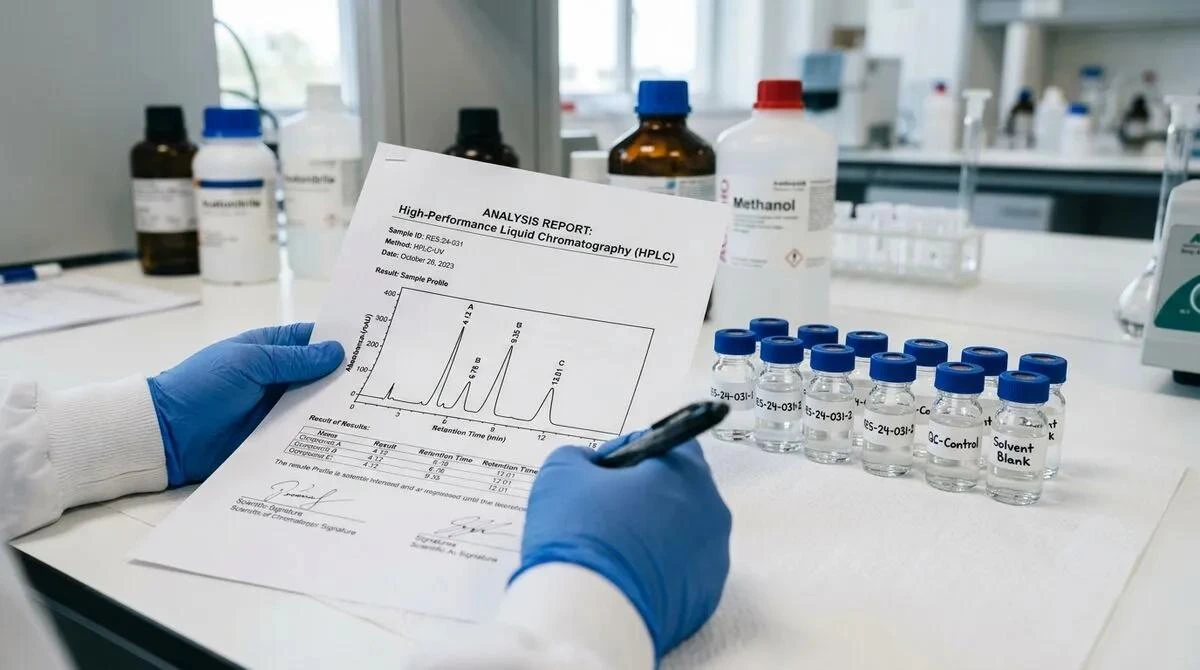
A Certificate of Analysis (COA) can contain several types of laboratory information, but understanding what each section means is essential before drawing conclusions from it. Simply finding a document labelled as a COA does not explain what was tested, which analytical methods were used or what the reported findings establish.
For research organisations and laboratory buyers in the UAE, a structured approach to reading these documents can make technical information easier to understand. It can also help distinguish laboratory findings from supplier descriptions and assumptions about related products.
Resources such as Remy Research provide access to research documentation and published peptide lab reports that readers can examine when learning how analytical information is presented.
1. Read the Report Header First
Begin with the basic information at the top of the COA. This section helps establish the context of the document before examining its analytical findings.
Depending on the laboratory’s reporting format, the header may include:
- Name of the testing laboratory
- Report or task reference
- Sample identification
- Material description
- Date of testing or report issuance
- Client or submission reference, where provided
Do not assume that every laboratory uses the same document structure. Some reports provide extensive sample information, while others use shorter reference fields.
The purpose of this first review is to understand what document you are reading and which submitted sample it concerns.
2. Understand the Sample Description
The sample description explains what material was submitted for testing. It may include a sample name, identifier, strength or other descriptive information.
This section deserves careful attention because laboratory findings apply to the sample identified in the report.
A product catalogue may associate several strengths or formats with one product family. Such supplier-mapped associations do not mean that every strength or format has been independently tested.
For example, a report associated with one specified sample should not automatically be treated as analytical confirmation for a different strength or presentation.
The same limitation applies to shipping inventory. A previously published report does not confirm the characteristics of a current shipping lot unless that specific lot is appropriately identified and tested.
3. Identify the Analytical Method
The analytical method section explains which procedure the laboratory used to examine the submitted sample.
Different methods are designed to evaluate different characteristics. Therefore, the method name should be considered before interpreting any result.
A COA may refer to chromatographic analysis or other analytical procedures. Readers should look for the method description and any additional notes explaining the scope of the test.
Avoid assuming that a report covers every possible quality characteristic. A method used to assess one analytical parameter cannot automatically establish unrelated characteristics.
When technical terminology is unfamiliar, the method description and the laboratory’s accompanying documentation provide a better starting point than the headline result alone.
4. Read the Results in Their Proper Context
The results section is often the most noticeable part of a COA. It may contain numerical values, chromatograms, tables or other analytical observations.
However, a number should never be interpreted without considering the measurement it represents.
For example, a chromatographic purity result relates to the particular method and sample used in the analysis. It should not automatically be interpreted as a measurement of total content, complete identity confirmation or sterility.
Similarly, different analytical measurements should not be combined into a general statement that a sample has passed every possible quality assessment.
A careful reader should ask:
- What parameter does this result measure?
- Which method produced the result?
- Does the report explain how the finding should be interpreted?
- Are any limitations or qualifications included?
These questions help keep conclusions within the scope of the reported evidence.
5. Check the Laboratory’s Report References
Laboratory documents may contain report numbers, task identifiers, sample references or verification information.
Where an official online verification facility is provided, follow the issuing laboratory’s own process. The verification method may differ between laboratories, so a task number or verification key should not be assumed to work across different systems.
Compare the available online record with the original document, paying attention to the relevant sample information and report reference.
If the laboratory does not provide online verification, retain the original report and use the available laboratory references when requesting clarification.
Document verification and scientific interpretation are separate steps: confirming a report’s record does not expand what its analytical results establish.
6. Recognise What a COA Cannot Confirm
A COA should be interpreted according to the testing actually documented.
Unless specifically supported by appropriate testing, a report should not be treated as proof of:
- Sterility or microbiological status
- Suitability for human or veterinary use
- Every possible impurity or contaminant being absent
- Characteristics of a different sample or batch
- Characteristics of a current shipping lot that was not tested
This distinction is particularly important when product descriptions cover multiple strengths or formats. A supplier association does not replace sample-specific laboratory evidence.
Readers should record what the document establishes and what remains unconfirmed rather than treating the presence of a COA as a universal quality guarantee.
7. Use a Consistent COA Review Checklist
A simple checklist can make document reviews more organised, especially when a research team handles several laboratory reports.
Before recording conclusions, check:
- Document identity: Is the issuing laboratory and report reference identifiable?
- Sample description: Is the tested sample clearly described?
- Analytical method: Is the procedure used by the laboratory stated?
- Reported findings: Is each result understood in relation to its measurement?
- Verification: Is an official verification process available?
- Testing scope: Are the limitations of the reported analysis understood?
- Recordkeeping: Is the original document retained with its relevant references?
This process does not replace technical laboratory evaluation. It provides a practical way to read the available documentation without making unsupported assumptions.
Final Thoughts
Reading a research peptide COA involves more than checking whether a report contains a laboratory name or a numerical result. Buyers should understand the sample description, analytical method, reported findings and limitations before interpreting the document.
For UAE research organisations, a consistent review process can make laboratory information easier to assess and record. Most importantly, findings should remain connected to the specific sample tested. Supplier-mapped product variations and previously published reports should not be treated as confirmation of a different or current shipping lot without appropriate supporting evidence.
Research-use-only notice: The materials discussed in this article are intended exclusively for in-vitro laboratory research. They are not intended for human or veterinary use. This article does not provide medical advice, treatment recommendations or administration instructions.